CLEVER will bring a network of links with NCBJ as a center to all four Partner Institutions:
- Laboratoire d’Astrophysique de Marseille, Marseille, France (LAM)
- Center for Astrophysics and Cosmology, University of Nova Gorica, Nova Gorica, Slovenia (CAC)
- Kapteyn Astronomical Institute, University of Groningen, Groningen, Netherlands (RUG)
- Leiden Observatory, Leiden University, Leiden, Netherlands (UL)
The project facilitates the exchange of doctoral students between institutes and, in the future, postdoctoral internships. In the long term, this will enable all Partners to strengthen cooperation between them, initiate new joint projects, and raise the reputation of NCBJ and Polish astrophysics in the international arena. Together with our partners, we plan to apply for observation time on telescopes belonging to the European Southern Observatory, on satellite telescopes (such as JWST), or, at the end of CLEVER, for large European projects such as ERC.
VISTULA Workshop
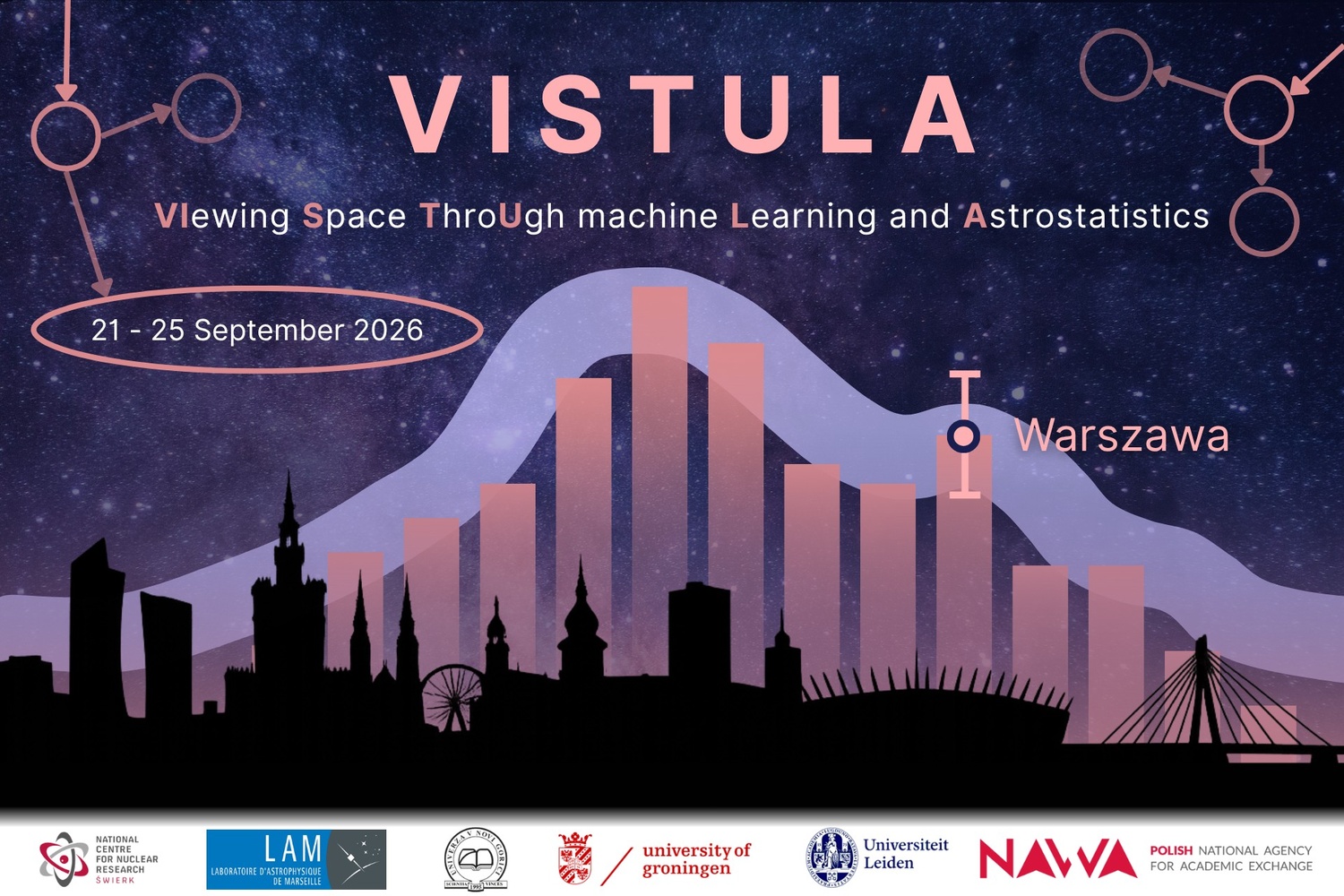
The workshop is organized as part of the project CLEVER: Cosmology & GaLaxy EVolution In The New ObsErving ProgRammes. Project founded by the Strategic Partnership project BPI/PST/2024/1/00019 by NAWA – Polish National Agency For Academic Exchange.
The rationale
Machine learning and modern statistical methods are becoming central tools in astrophysics and cosmology, from survey data reduction and photometric redshifts to time‑domain discovery, image classification and parameter inference. This workshop offers a structured introduction to statistical foundations and machine learning concepts.
The goal of this workshop is to provide a structured, beginner‑friendly entry point to machine learning and advanced statistics in astrophysics, while progressively reaching more advanced topics. The format will combine morning lectures with afternoon hands‑on sessions in which participants work through concrete astrophysical use cases under the guidance of the invited speakers and local tutors.
The workshop is aimed at Master’s students, early‑stage PhD students and junior researchers from NCBJ, the University of Warsaw, and the CLEVER partner institutions. It will explicitly welcome participants with limited prior exposure to machine learning, provided they are comfortable with basic programming (e.g. Python) and standard statistical concepts. By the end of the workshop, participants should be able to: understand the main families of machine learning methods used in current astrophysical research; critically assess when a machine‑learning approach is appropriate; implement and evaluate simple models on real data; and recognise common pitfalls such as overfitting, data leakage and biased training sets.
The invited speakers span a broad range of applications including galaxy formation and evolution, large‑scale surveys, time‑domain and transient astronomy, exoplanets and cosmology.
Hosted in Warsaw as part of the CLEVER-NAWA partnership , the workshop will strengthen training and collaboration across the network by bringing together students, junior researchers, and invited experts for a hands-on introduction to machine learning and advanced statistics in astrophysics.
Invited speakers:
- Ting-Yun Cheng (Kapteyn Astronomical Institute in Groningen)
- Antonio La Marca (Leiden Observatory, European Space Agency)
- Alex Razim (Centre for Astrophysics and Cosmology, Nova Gorica)
- Carlo Schimd (Laboratoire d’Astrophysique de Marseille)
- Will J. Pearson (National Centre for Nuclear Research)
For more info, or to register for the workshop, CLICK HERE
Project partners