- Strona główna
- Seminars
The seminar series is organized within the framework of the NAWA Strategy-funded CLEVER project at NCBJ. The programme strengthens international collaboration in astrophysics by building long-term scientific links between NCBJ and its partner institutions:
- Laboratoire d’Astrophysique de Marseille (LAM), France
- Center for Astrophysics and Cosmology, University of Nova Gorica (CAC), Slovenia
- Kapteyn Astronomical Institute, University of Groningen (RUG), The Netherlands
- Leiden Observatory, Leiden University (UL), The Netherlands
The researchers from partner institutions regularly visit NCBJ to present seminars covering galaxy evolution, extragalactic astronomy, machine learning applications in astrophysics, transient phenomena, and multi-wavelength surveys. The seminar series is ongoing and will continue to feature invited speakers from the CLEVER network and beyond. The visitors also participate in outreach activities, including Astronomy on Tap events organized by BP4 department of NCBJ.
Past and Upcoming Seminars
24th March 2026
Deep learning for detecting galactic interstellar filaments
prof. Annie Zavagno (Laboratoire d’Astrophysique de Marseille, France)
Filaments are sites of star formation in galaxies. The study of their properties has attracted much attention since the Herschel far infrared telescope revealed their ubiquity in the interstellar medium of our galaxy. Moreover, the formation of stars can be studied through the properties of filaments that host this process. However, in order to study these properties, the filaments must first be extracted from the data. Filaments are complex structures that form and evolve within the interstellar medium. Physical conditions (local density, temperature and magnetic field intensity) strongly influence their properties. Unbiased detection is essential to understanding their formation and evolution and tracing their life cycle, which includes the star formation process. Classical detection algorithms suffer from various biases that hinder unbiased detection of filaments. In this talk, I will present the results of our work exploring the potential of machine learning to detect such filaments. I will also discuss the limitations of this work and present some of the approaches we are considering.
20th April 2026
Gamma-ray bursts and their host galaxies
Dr. Benjamin Schneider and Dr. Veronique Buat (Laboratoire d’Astrophysique de Marseille, France)
Gamma-ray bursts (GRBs) are among the most energetic transient phenomena known in the universe. The association of so-called “long” GRBs with the end of life of massive stars directly links them to galaxies with very active star formation. The interstellar medium of these galaxies leaves its imprint on the GRB spectrum, enabling a unique study of its different components over a wide range of redshifts and independently of the luminosity of the host galaxy. However, several questions remain open, ranging from the nature and diversity of the progenitors to how representative GRB host galaxies are within the overall population of star-forming galaxies.
In this seminar, we will present recent results from the Sino-French SVOM mission, launched in mid-2024 and dedicated to the study of GRBs, along with follow-up observations of supernovae associated with GRBs obtained with the JWST. We will show how the study of GRB host galaxies will be transformed by data from major extragalactic surveys such as Euclid and in the near future LSST. Finally, we will highlight the unique potential of GRBs to probe dust extinction and attenuation by analyzing a few GRB—host galaxy pairs.
21st April 2026
Understanding galaxy quenching: from ground-based spectroscopy to space imaging
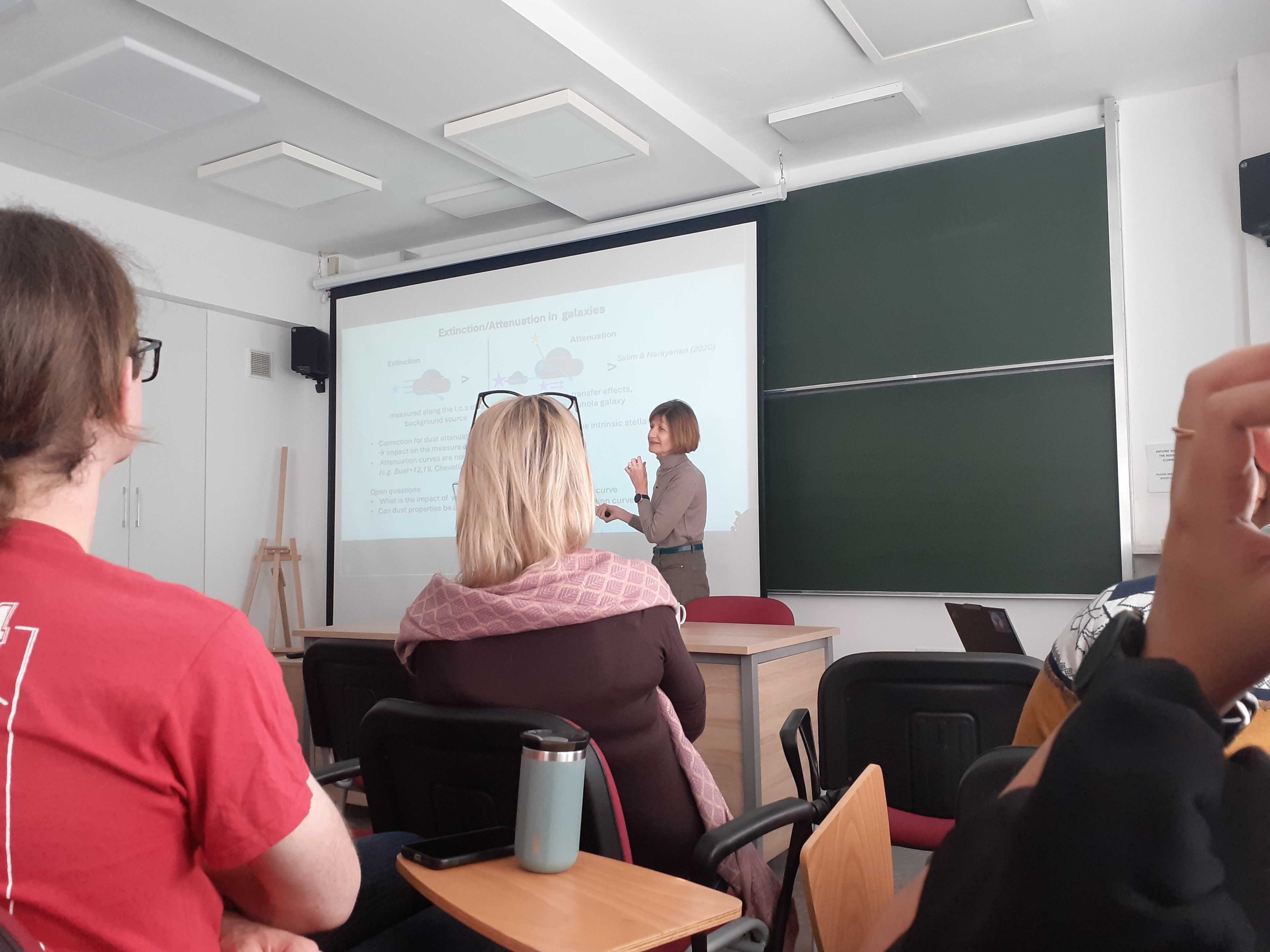
Dr Pablo Corcho Caballero (Kapteyn Astronomical Institute, University of Groningen, Netherlands)
The cessation of star formation in galaxies, commonly referred to as quenching, is a fundamental process in galaxy evolution. In the nearby Universe, nearly 20 to 30% of galaxies exhibit little or no ongoing star formation, yet the physical mechanisms driving this transformation remain poorly understood. In this talk, I will present recent results aimed at constraining the processes that shape the distribution of galaxies across different levels of star formation activity, with a particular focus on recently quenched systems. For this, I will use a diverse set of observational datasets, ranging from IFU spectroscopy to high-resolution imaging from Euclid, complemented by predictions from cosmological hydrodynamical simulations. The talk will begin by introducing key concepts related to the distribution of galaxies in the stellar mass-sSFR plane, including the question of whether galaxies truly "die". I will then present a set of observational and theoretical diagnostics designed to distinguish between rapid (quenching-driven) and slow (secular) evolutionary pathways, highlighting their implications for the physical properties of recently quenched galaxies. Finally, I will discuss early results from the first Euclid Quick Data Release, along with ongoing efforts in preparation for the upcoming full data release.
25th May 2026
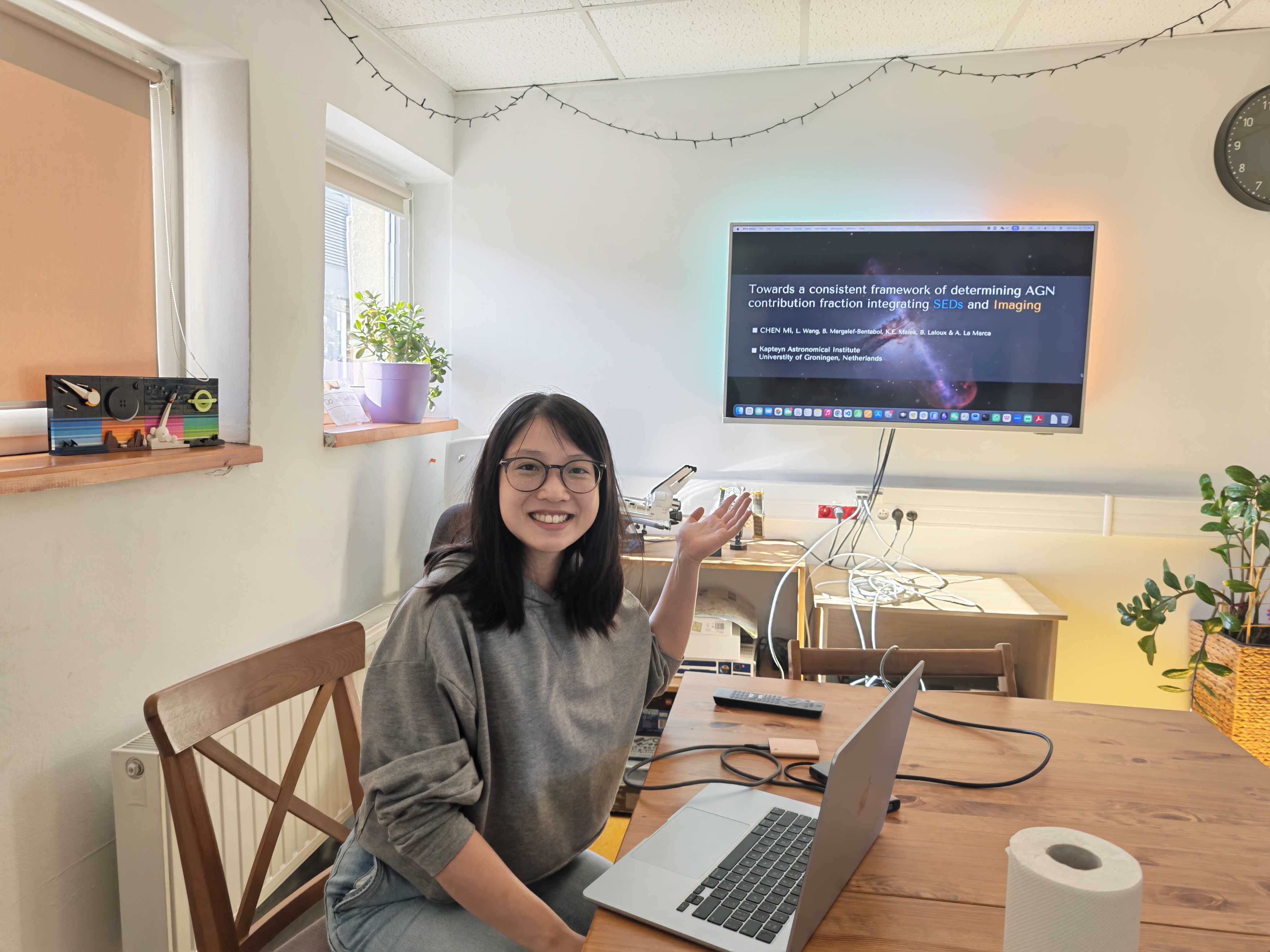
Towards a consistent framework for determining active galactic nucleus contribution fractions and host galaxy properties
Mi Chen (Kapteyn Astronomical Institute, University of Groningen, Netherlands)
Decomposing active galactic nucleus (AGN) emission from host-galaxy light is essential for identifying AGN-dominated systems and accurately deriving host-galaxy physical properties. However, estimating AGN contributions from multi-wavelength photometry remains challenging due to inherent parameter degeneracies in spectral energy distribution (SED) fitting. In this work, we establish a unified framework for estimating AGN contribution fractions and host-galaxy properties by combining complementary diagnostics: SED decomposition with two independent fitting codes, CIGALE and GRAHSP, and deep-learning-based imaging decomposition. We apply this framework to galaxies in the COSMOS-Web field using multi-wavelength photometry from the ultraviolet to the far-infrared. We calculate the AGN contribution fraction in the JWST/NIRCam F150W filter and compare the SED-derived estimates with independent AGN fractions obtained from deep-learning image decomposition. Our results reveal significant degeneracies in current SED-fitting approaches based on empirical or theoretical AGN templates, and demonstrate that incorporating independent morphological information can help break these degeneracies and improve the reliability of AGN and host-galaxy property estimates.